INVEST Criteria for Agile User Stories in Scrum

In the Agile and Scrum way of working, user stories are your best investments. Do you know why? They represent the work needed to build a product that every customer will love. But, unfortunately, not all stories are created equally well-structured and mannered.
Poorly defined stories lead to wasted time and missed goals. Unclear requirements are a top reason why projects fail. In fact, teams mostly spend over 20% of their time on rework due to poor planning. So how do you decide which ones are worth the team’s effort?
In this article, you get a complete checklist to pick the best user stories, so that your team builds the right things, the right way.
What Does INVEST Stand For?
INVEST is an acronym term introduced by Bill Wake’s article “ INVEST in Good Stories, and SMART Tasks “in 2003 that represents six essential qualities every user story should possess.
Each letter represents a critical characteristic that enables teams to create stories that are actionable, clear, and valuable.
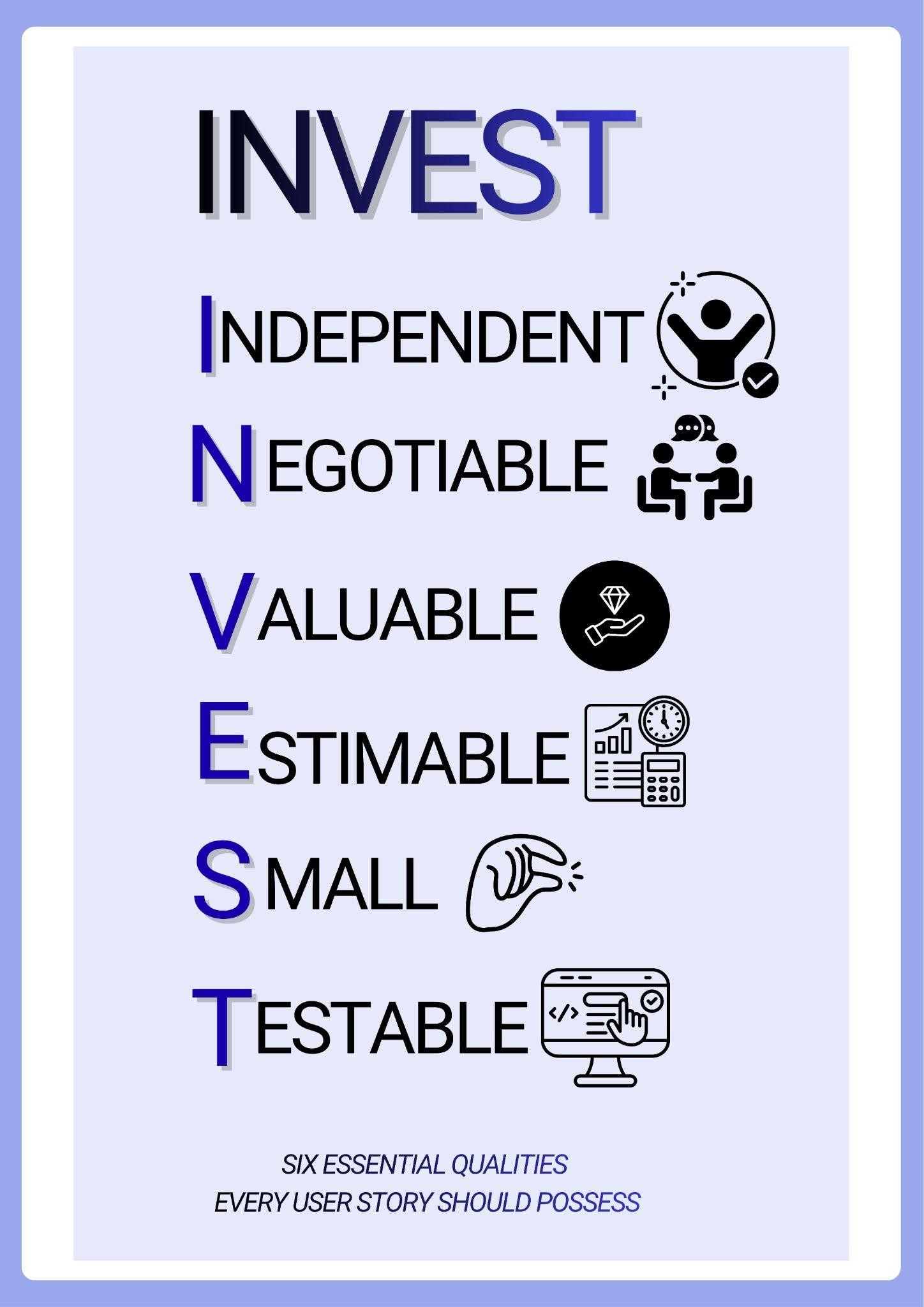
Independent:
- Stories should stand alone without depending heavily on other stories.
- Importance: This independence allows teams to work on multiple items simultaneously and reorder priorities without creating bottlenecks.
Negotiable
- User stories aren’t rigid contracts but conversation starters.
- Importance: They should leave room for discussion between the development team and product owner, allowing for creative solutions and adjustments as understanding grows.
Valuable:
- Every story must deliver clear value to the customer or end user.
- Importance: If you can’t articulate why a story matters to users, it might not be worth pursuing.
Estimable:
- Teams need enough information to estimate how long a story will take.
- Importance: If a story is too vague or complex to estimate, it needs clarification or breakdown.
Small:
- Stories should be sized to fit within a single sprint, typically completable in a few days.
- Importance: Smaller stories reduce risk, enable faster feedback, and keep momentum high.
Testable:
- Each story needs clear acceptance criteria that define when it’s complete. Importance: Without testable conditions, teams can’t confirm they have met requirements or maintain quality standards.
Why is the INVEST Principle Important in Scrum?
The INVEST criteria directly support Scrum’s iterative approach and focus on delivering a working product regularly.
When user stories meet these standards,
- Sprint planning becomes more predictable,
- Daily standups focus on real progress, and
- Sprint reviews demonstrate tangible value to stakeholders.
Teams that consistently apply INVEST principles experience fewer mid-sprint surprises and scope creep.
- Product owners can prioritize more effectively when stories are independent and valuable.
- Developers can estimate with greater confidence when stories are small and estimable.
So, the entire Scrum framework functions more smoothly.
How to Develop a Great User Story: Practical Application Tips
A 5-Point Checklist for a Great User Story:
Your team’s time and effort are precious capital. Before you “spend” it on a user story, use this simple set of criteria to evaluate its potential.
1. Does It Pass the “INVEST” Test?
A good user story should follow the above-mentioned “INVEST” Principle.
| If a story fails any of these, it’s a high-risk investment. Refine the user stories until they pass. |
2. Is the “Why” Crystal Clear?
Every story must answer a simple question: “Why are we building this?” The development team needs to understand the user’s underlying need, not just the task.
A strong connection to the “why” boosts motivation and sparks creative solutions that a simple instruction might miss. It ensures the team is building the right thing.
3. Are the Acceptance Criteria Specific?
Acceptance criteria are your quality assurance checklist. They turn a vague idea into a concrete, testable requirement. Instead of “The login should be secure,” good criteria would be:
“After three failed login attempts, the account is locked for 15 minutes.”
“A success message is displayed upon a valid login.”
Clear criteria prevent misunderstandings and reduce the back-and-forth between developers and testers, saving enormous time.
4. Does It Deliver User Value on Its Own?
Avoid stories that are just “technical tasks” with no visible user benefit.
For example, “Set up the database” is a task. A user story would be,
| “As a registered user, I can save my profile information so that I don’t have to re-enter it each time.” |
The latter delivers tangible value and is more motivating to build.
5. Is It Understood by Everyone?
Never start a story that the team doesn’t fully understand. The Product Manager must explain the “what” and “why,” and the development team must feel confident they know “how” to build it. This shared understanding is forged during backlog refinement sessions and is non-negotiable for a successful sprint.
How To Gain Proper Knowledge on Setting INVEST Criteria:
The setting of INVEST Criteria for Agile User Stories in Scrum is a crucial skill. It prevents wasted effort. As a professional, if you are ready to advance your Career with CSM certification, you will get demonstrable ability to increase team efficiency and product quality by applying these skills effectively.
Conclusion
The INVEST criteria remain remarkably relevant two decades after their introduction because they address fundamental challenges in Agile development.
By ensuring user stories are independent, negotiable, valuable, estimable, small, and testable, teams create a foundation for successful sprints and satisfied stakeholders.
Start applying INVEST consistently, and you will notice improved clarity, better planning, and more predictable delivery. The investment in learning these criteria pays dividends throughout your Agile journey.