The Rise of Collaborative Intelligence: How AI Agents Are Reshaping the Future of Work
A New Era of Work Dynamics
For decades, business leaders equated digital transformation with efficiency—deploying systems that automated repetitive tasks to reduce errors, cut costs, and accelerate output. These early forms of automation delivered significant benefits, yet they remained confined to narrow, rule-based processes. The real challenge for organizations—navigating uncertainty, making rapid decisions, and scaling innovation—still rested firmly in human hands.
That equation is changing. Today’s enterprise technology introduces a new kind of collaborator: the ai agent. Unlike traditional automation scripts or software bots, these intelligent counterparts interpret context, learn from interactions, and assist humans in solving complex, dynamic challenges. The shift represents not just an operational upgrade, but a reimagining of how businesses structure teams, allocate responsibilities, and define leadership in the age of collaborative intelligence.
From Efficiency to Collaboration
The earliest automation tools were reactive—they followed commands but lacked awareness. AI agents, by contrast, are proactive. They can anticipate needs, analyze unstructured data, and adapt as situations evolve. This capacity enables them to function not merely as tools, but as collaborative partners alongside human teams.
Consider the difference between a traditional bot that processes invoices and an AI agent embedded in a finance department. The bot executes a fixed workflow. The agent, however, can detect anomalies in financial data, cross-reference supplier performance, and recommend negotiation strategies. It doesn’t just save time—it actively contributes to smarter business decisions.
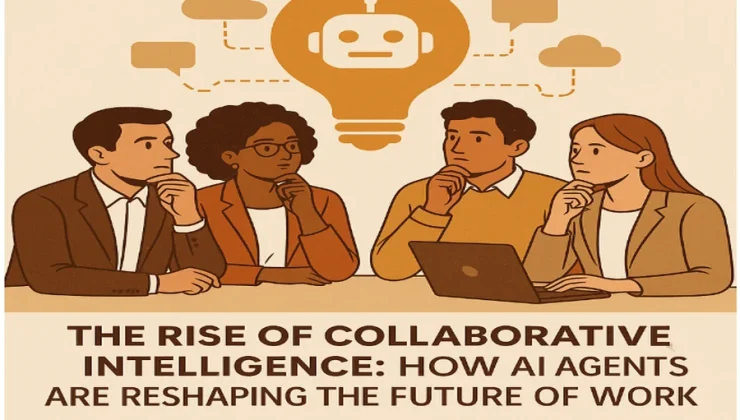
This leap transforms the way organizations view technology. No longer confined to back-office tasks, intelligent systems now sit at the table—literally and figuratively—shaping strategy with leaders and staff alike.
Practical Applications Across Industries
The value of AI agents is most visible in real-world scenarios where speed, complexity, and adaptability converge.
Healthcare: Beyond scheduling and billing, AI agents analyze patient histories, identify early-warning signs in diagnostic data, and recommend treatment pathways. By collaborating with medical professionals, they reduce cognitive overload and improve patient outcomes.
Financial Services: In banking, agents continuously monitor global transactions to identify fraud patterns in real time. They also assist compliance teams by instantly mapping new regulations to existing operations, ensuring organizations stay ahead of evolving rules.
Supply Chain Management: Modern supply chains face volatile demand, geopolitical disruptions, and unpredictable logistics. AI agents forecast risks, reroute deliveries in response to disruptions, and optimize warehouse operations. This ability to react in the moment minimizes costly delays while increasing resilience.
Customer Service: Agents don’t just answer FAQs—they track historical interactions, sentiment, and purchasing behavior to tailor solutions. By pre-empting issues, they transform reactive service into proactive engagement, elevating customer experience while reducing churn.
Leadership in the Age of Agents
For executives, adopting AI agents is not just about technology procurement—it’s about reshaping organizational culture. Leaders must establish a vision where human creativity and machine intelligence complement one another. That means training teams, fostering trust, and building governance structures that ensure transparency in decision-making.
Communication is equally critical. Employees who view AI systems as replacements often resist adoption. But when positioned as collaborators that handle complexity and free humans for more strategic, interpersonal, or creative tasks, agents are embraced. The narrative shift—from replacement to empowerment—is key to sustainable integration.
Data as the Bedrock of Intelligence
AI agents rely on clean, integrated data ecosystems. Fragmented, siloed information limits their potential. By investing in unified data platforms and tools like Profit.co performance management software, executives unlock the full capability of these systems to connect the dots across departments.
Imagine a scenario where customer complaints, supply chain data, and financial performance are all fed into a single intelligent framework. An AI agent can then identify root causes behind complaints, correlate them with delivery disruptions, and forecast potential revenue impact. This type of holistic, cross-functional insight is what makes agents truly game-changing.
Barriers and How to Overcome Them
Despite their promise, adoption is not frictionless. Integration with legacy systems often requires substantial IT investments. Security remains a paramount concern, as agents deal with sensitive data that must be protected from breaches. And accountability poses a unique challenge: when an agent recommends a course of action, who ultimately owns the outcome?
Forward-thinking organizations are responding with hybrid governance models. These frameworks clearly delineate where AI has autonomy and where human oversight is non-negotiable. Such approaches ensure agents add value without eroding responsibility, building confidence among employees, customers, and regulators.
Scaling Agents Across the Enterprise
The true strategic advantage emerges when AI agents are deployed not in isolation but across the enterprise. A customer support agent that predicts service delays creates more value when connected with a logistics agent that has already rerouted shipments and a finance agent that has updated revenue forecasts. Together, they form an interconnected ecosystem that amplifies foresight and agility across the organization.
This interconnectedness positions AI agents as orchestrators of workflows, bridging silos and ensuring all departments move in alignment. At scale, they become more than assistants—they evolve into enterprise-wide collaborators that empower leaders to anticipate challenges and seize opportunities faster than their competition.
The Human-AI Partnership of Tomorrow
As the technology matures, the vision of work will shift further toward collaboration. Organizations will not measure AI success solely in hours saved, but in opportunities created, markets penetrated, and innovations accelerated. Leaders will judge success by how effectively human expertise and machine intelligence complement one another.
Ethical considerations will remain central. Transparency in decision-making, fairness in algorithms, and accountability in outcomes must guide adoption. Businesses that embed these principles into their deployment strategies will not only achieve competitive advantage but also maintain trust among stakeholders.
Conclusion: A Redefined Future of Work
AI agents are redefining the workplace. They represent a pivot from automation as a back-office efficiency play to a central driver of strategy, collaboration, and resilience. For leaders, the challenge is not whether to adopt them, but how to integrate them thoughtfully, ensuring they serve as partners rather than disruptors.
This is the rise of collaborative intelligence—an era where machines don’t replace human ingenuity but amplify it. Businesses that embrace this shift will not just keep pace with change; they will shape the future of work itself.