The Speed of Motion: How Dreamina Seedance 2.0 Mini Image to Video is Streamlining Creative Production
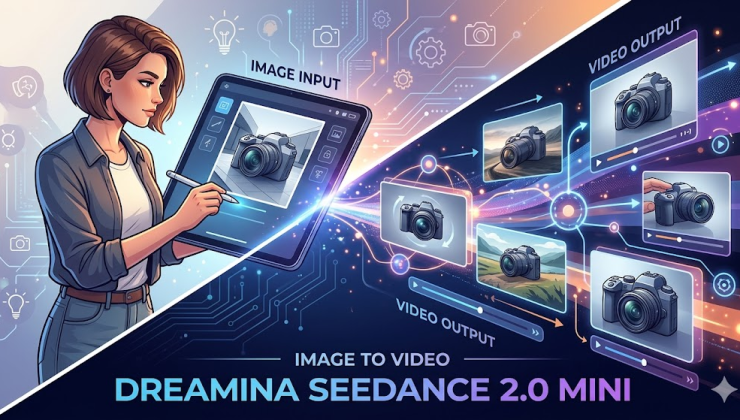
The timeline of digital media consumption has accelerated to a point where static graphics alone struggle to maintain audience attention. As algorithms across major social and professional platforms continue to favor dynamic layouts, creative teams face a persistent operational bottleneck: the considerable time, specialized cost, and technical friction required to convert static design assets into compelling, high-fidelity video.
Addressing this structural challenge, the Dreamina Seedance 2.0 Mini image to video update introduces an efficient, localized approach to generative motion synthesis, tailored explicitly for high-velocity multi-platform workflows.
By decoupling advanced video generation from high-end local hardware configurations and complex, steep-learning-curve prompting environments, this iteration positions itself as a practical workplace utility rather than an experimental novelty. For enterprise marketing departments, independent content creators, and agile digital agencies alike, the tool offers a highly scalable framework to bridge the gap between static graphic design and active audience engagement.
Overcoming the Artifact Dilemma in AI Video
Historically, transforming a single two-dimensional graphic into a fluid video sequence came with distinct technical trade-offs that restricted its use in professional settings. Early generative AI video frameworks frequently suffered from geometric distortion and "morphing" artifacts, where structural boundaries—such as the sharp, straight lines of product packaging, corporate branding, or the symmetry of a human subject—would warp or dissolve unpredictably during simulated camera movements.
The underlying architecture powering the Dreamina Seedance 2.0 Mini image to video utilizes an upgraded temporal consistency engine specifically engineered to mitigate these exact limitations. By preserving the precise spatial coordinates and visual layout of the original input image, the model predicts and executes motion pathways that respect the natural physics of the scene.
Whether animating a subtle, cinematic camera drift across a complex landscape or introducing intricate object manipulation within a frame, the tool ensures that structural integrity and visual continuity remain perfectly intact from the first frame to the last.
Compression of the Production Lifecycle
In competitive commercial environments, creative tools are heavily evaluated by their direct impact on project turnaround times and resource allocation. Traditional 2D/3D animation, frame-by-frame rendering engines, and manual motion tracking require specialized expertise, expensive local hardware, and significant hours of labor. The "Mini" model addresses this operational friction by prioritizing rapid backend rendering speeds and minimal computational overhead for the end user.
┌──────────────────────────┐
│ Static Image Asset Upload│
└─────────────┬────────────┘
│
▼
┌──────────────────────────┐
│Dreamina Seedance 2.0 Mini│ ──► [Real-Time Motion Synthesis Engine]
└─────────────┬────────────┘
│
▼
┌──────────────────────────┐
│ 1080p Motion Sequence │ ──► [Ready for Export & Deployment]
└──────────────────────────┘
Through a streamlined, browser-accessible interface, users can upload an asset, input text-based directional instructions, and receive a high-definition, 1080p video clip within seconds. This rapid processing capability enables real-time iterative changes on the fly. Design teams can prototype dozens of varied movement styles, camera angles, and pacing options in a fraction of the time typically required to render a single traditional composition loop.
Multi-Reference Control and Project Versatility
Beyond standard single-image conversions, the system introduces expanded project versatility by supporting comprehensive multi-reference assets. Creators are no longer limited to simple text commands or single isolated images; they can seamlessly combine multiple creative components to direct the final output with precision.
- Multimodal Asset Ingestion: Users can orchestrate complex visual projects leveraging up to 12 distinct reference clips, combining source images, structural text guides, and specific audio patterns simultaneously.
- Intelligent Screen Rhythm: The generative engine doesn't merely animate randomly; it actively aligns the structural rhythm, text styling, and visual transitions with the underlying pacing and beats dictated by the user's audio inputs.
- Precision Keyframe Modes: Advanced options allow creators to lock specified frame constraints—such as defining distinct starting and ending keyframes—ensuring the AI accurately renders the exact transition pathway required for narrative consistency.
This degree of granular control makes the Dreamina Seedance 2.0 Mini text to video and image conversion capabilities exceptionally versatile for complex narrative layouts, video essays, and promotional rollouts.
Cross-Industry Use Cases and Practical Implementations
The practical deployment of the Dreamina Seedance 2.0 Mini framework extends across various commercial sectors looking to scale their digital output efficiently without compromising on brand identity.
B2C Marketing and E-Commerce
For e-commerce brands navigating high ad-fatigue rates on visual social feeds, keeping storefronts and social feeds updated with fresh content is a constant operational demand. Instead of scheduling frequent, costly, and logistically complex product photography shoots for every single promotional variation, marketing teams can utilize existing product catalogs and lifestyle photography to generate diverse, high-converting video variations on demand.
Digital Journalism and Multimedia Publishing
Modern editorial platforms rely heavily on rich media to drive page engagement, click-through rates, and user dwell time. Editorial designers and digital journalists can instantly animate conceptual illustrations, infographics, or historical photographs. This allows them to embed mini-documentary clips, animated explainers, or dynamic website headers directly into feature articles to enhance reader immersion without slowing down fast-paced publishing schedules.
Creative Agency Pre-Visualization
Pitching complex visual campaigns to stakeholders often stalls or experiences friction due to abstract, flat storyboards that fail to capture the energy of a concept. By converting flat sketches, concept art, or mood board graphics into moving, cinematic previews, agencies can clearly communicate lighting directions, camera framing, spatial depth, and pacing before securing production budgets or moving into full-scale filming.
Autonomy and Control in Creative Direction
A common, valid criticism of generative media tools is the perceived loss of user intent and artistic control during the automation process. The updated framework addresses this critique directly by positioning the artificial intelligence as a supportive infrastructure rather than an automated replacement for human talent. While the machine handles the mathematically complex calculations regarding fluid dynamics, cloth movement, environmental lighting angles, and frame interpolation, the creator retains strict control over aesthetic parameters, formatting, composition, and pacing.
This deliberate balance between automated backend rendering and manual frontend configuration effectively democratizes high-fidelity motion graphics. It enables small internal teams and independent studios to easily match the production scales of larger enterprises, shifting the competitive edge back toward conceptual originality, strong storytelling, and strategic vision rather than sheer budget size or hardware constraints.
Scalable Infrastructure for the Future
As digital landscapes continue to transition toward immersive, reactive, and highly visual media ecosystems, tools that simplify asset translation and cross-format adaptation will remain foundational to modern production pipelines.
The performance and consistency improvements showcased in this release highlight a broader, industry-wide trend toward lightweight, efficient, and accessible creative utilities. By stabilizing motion output and removing steep hardware barriers, the engine establishes an accessible, professional baseline for integrated, high-frequency multimedia storytelling.